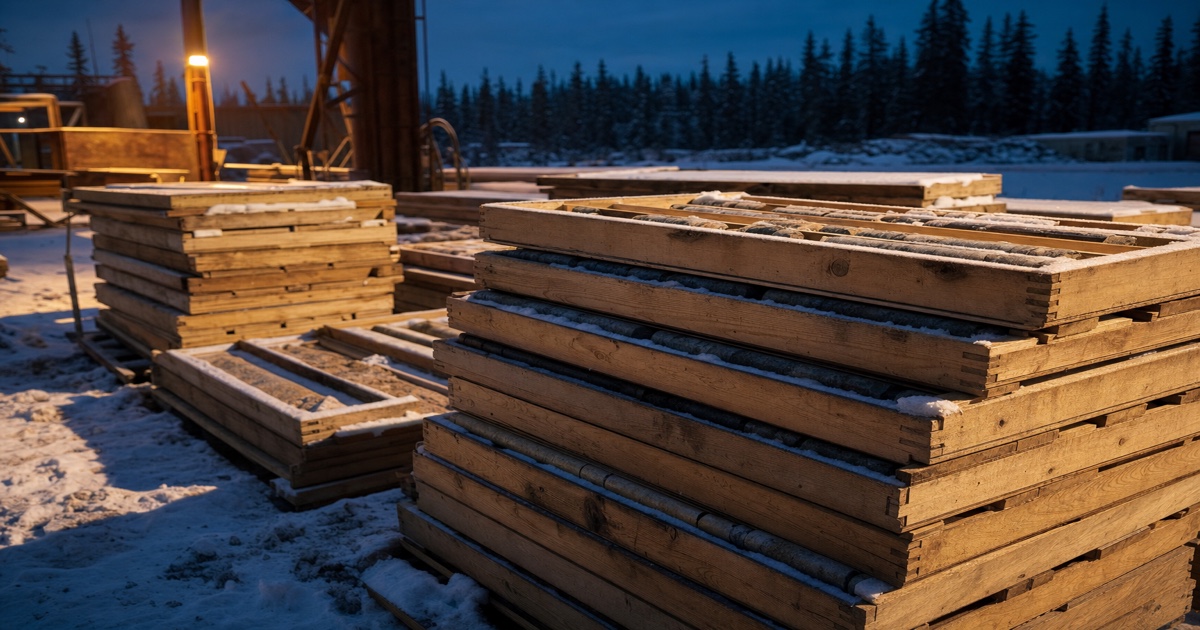
Wooden core boxes and plastic core trays both store drill core — the right choice depends on your program, not on marketing. Plastic wins on washability and consistent tare weight, which matters for chip trays and some lab workflows. Wood wins on upfront cost, field repairability, cold-weather performance, stacking strength under snow load, and freight — especially in Canada, where a kiln-dried spruce box ships from a domestic mill instead of an import warehouse. For a typical Canadian Shield exploration program storing NQ or HQ core outdoors across multiple winters, framed wooden boxes remain the default for a reason: a crew can fix a cracked wall with a hammer and four nails at minus thirty, and a pallet of spruce boxes costs meaningfully less landed than the plastic equivalent. We build wooden core boxes, so read this knowing where we stand — but we've kept the comparison honest, because plenty of programs genuinely should run plastic for part of their workflow.
Why we’re writing this comparison
If you search for plastic core trays, you’ll find content arguing nobody should ever buy a wooden core box again — written by companies that sell plastic ones. We sell wooden ones, so you should weigh our view the same way. But after ninety years of milling wood products for the Canadian exploration industry, we’d rather lay out the real trade-offs than pretend there aren’t any. Some programs should run plastic. Most Canadian programs, in our experience, are still better served by wood — and the reasons are practical, not sentimental.
The honest comparison
| Factor | Wooden core boxes | Plastic core trays |
|---|---|---|
| Upfront cost per box | Lower — domestic lumber, domestic mill | Higher — molded product, usually imported |
| Freight to site | Ships from a Canadian mill | Often imported, longer supply line |
| Field repair | Hammer and nails, ten minutes | Not repairable — replace |
| Deep-cold performance | Spruce stays tough at -40 | Many plastics go brittle in deep cold |
| Stacking under snow load | Framed walls carry weight | Varies by design; nesting walls can rack |
| Washability / reuse | Not washable; single program per box, repairable | Washable, reusable across programs if undamaged |
| Tare weight consistency | Varies slightly with moisture | Consistent — useful for lab weighing |
| End of life | Biodegradable, burnable, reusable as lumber | Recyclable only where facilities exist |
The three arguments against wood — answered
The case against wooden core boxes usually rests on three claims: questionable wood sourcing, poor durability, and worker safety. Each one has a kernel of truth about badly made boxes and says very little about well made ones.
- “You don’t know where the wood comes from.” That’s a real concern in unregulated supply chains. It is not a concern with Canadian provincial timber. Our spruce is harvested under Manitoba forest management licensing and milled in Cranberry Portage, three hours from where it grew. The supply chain is one truck.
- “Wood degrades outdoors.” Wood milled wet degrades outdoors. Spruce kiln-dried to 10–12% moisture content stabilizes in the Shield’s dry continental air instead of checking apart, and a framed 2×6″ box stays serviceable through 5–8+ winters of outdoor stacking. We’ve watched import boxes built at warm-climate moisture content come apart in one season — that’s a manufacturing problem, not a material problem.
- “Wood is heavy and unsafe to handle.” A loaded HQ box is heavy whatever it’s made of — the core is the weight. The handling answer is box design (rigid walls, solid end grips, predictable stacking) and crew practice, not material swap. As for the claim that dangerous animals hide in wooden boxes: on the Canadian Shield, the wildlife risk inside your core box rounds to zero, twelve months a year.
When plastic genuinely wins
Fair is fair. If your core is going straight into a heated core shack, getting logged, sampled, washed, and re-racked through many handling cycles, plastic trays earn their price — they rinse clean, nest when empty, and weigh the same every time, which some labs like. Chip trays for RC drilling are plastic for good reason. And if your program is in a climate where freeze-thaw isn’t a factor and local lumber is expensive, the math shifts. None of those conditions describe a typical winter drill program north of the 53rd parallel.
What we build instead
Our answer to the durability argument is the CanadaCoreBox — kiln-dried Canadian spruce in three constructions: plywood for indoor core libraries, 2×6″ framed for outdoor stacking through Manitoba winters, and 2×8″ framed for PQ and the deepest HQ programs. All in the industry-standard 4′9″ inside length, so they stack and rack interchangeably with any standard box. If you’re weighing wood against plastic for a Canadian program, send us your bit size and meterage and we’ll quote it straight — and tell you honestly if we think plastic suits part of your workflow better. Full sizes, specs, and shipping coverage are on our wooden core boxes Canada page.
Frequently asked questions
Are wooden or plastic core boxes better for drill core storage?
Neither is better in every case. Plastic trays are washable, nest when empty, and have consistent tare weight — useful for chip trays and lab-heavy workflows. Wooden boxes cost less upfront, can be repaired in the field with basic tools, handle deep-freeze conditions without going brittle, and stack stronger under snow load. For multi-winter outdoor storage in Canada, framed wooden boxes are still the standard choice on most exploration programs.
Do wooden core boxes rot or fall apart outdoors?
Poorly made ones do. A wooden core box milled at warm-climate moisture content will check and loosen when it dries out in the Canadian Shield's continental air. Boxes milled from kiln-dried spruce at 10–12% moisture content stabilize instead of checking, and framed 2×6" or 2×8" construction stored outdoors typically lasts 5–8+ years. Material preparation matters more than the material itself.
Is the wood in core boxes sustainably sourced?
Canadian lumber is among the most regulated forest product supply chains in the world. Our spruce is sourced regionally in Manitoba under provincial forest management licensing, milled three hours from where it grew, and the box itself is biodegradable and repairable rather than a single-use molded product. Concerns about illegal logging apply to unregulated supply chains, not to Canadian provincial timber.
Are plastic core trays cheaper than wooden core boxes?
Per unit, plastic trays generally cost more upfront than wooden boxes, and most plastic systems sold in Canada are imported, which adds freight. The plastic case is usually argued on reuse over many cycles. That math can work for core shacks and lab settings with controlled handling, but on remote sites where boxes get craned, sledded, helicopter-slung, and stacked under snow, damage rates rise and the reuse assumption weakens.
Can you repair a core box in the field?
A wooden box, yes — a cracked wall or popped corner is a hammer, a handful of nails, and ten minutes. Any camp has the tools. A cracked plastic tray is done; it can't be field-repaired and the broken tray still has to be flown or trucked out. On fly-in programs that difference is real money.
What does cold weather do to plastic core trays?
Most commodity plastics lose impact resistance as temperatures drop, and at the minus-30 to minus-40 conditions common on winter drill programs they can crack under impacts a wooden box shrugs off. Spruce keeps its toughness in deep cold. If your program drills through a northern winter, cold performance should be one of your first questions to any supplier, plastic or wood.
Need a quote on a real drilling program?
Tell us your meterage, your bit size, and your timeline. We'll come back with a real number — usually the same day.
Get a quote