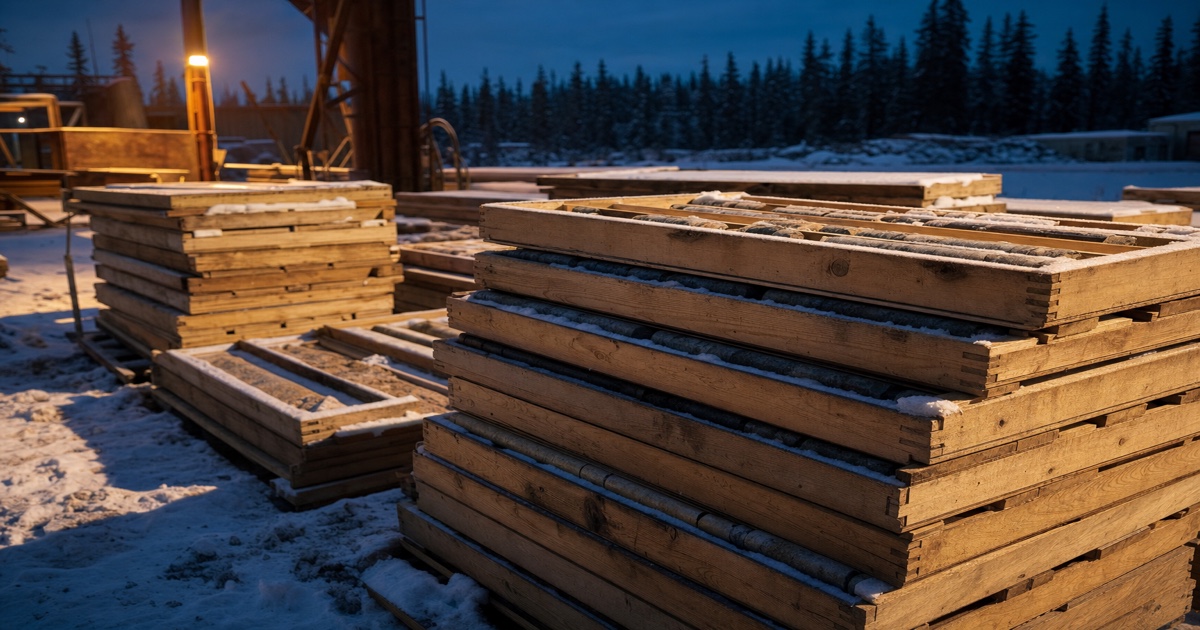
Rough-grade lumber in Manitoba is dimensional or oversized wood that's been milled but not planed smooth — saw-textured face, full sawn dimensions, knots and natural character left in. Contractors use it for outdoor structures (decks, pole barns, fences, timber framing), industrial pallets and dunnage, agricultural builds, and any application where the rustic mill-cut look is the finish. The two questions to answer before ordering are species (white spruce vs. jack pine vs. black spruce, depending on what's coming through the local mills) and grade tolerance (true rough-cut vs. rough-sawn-then-skip-planed, which look similar but behave differently when you're framing to a square). We mill rough-cut lumber from regional Canadian softwoods at our shop in Cranberry Portage and ship across Manitoba, Saskatchewan, and into northern Ontario.
What rough-cut actually means
When a log comes off the sawmill, the boards leave the saw with a textured face — the marks of the blade still visible, the full sawn dimension intact. Planing is a separate step that shaves the face smooth and brings the dimension down by 1/4 to 1/2 inch per side. Rough-cut lumber skips the planing. You get full sawn dimensions, saw-textured faces, and the wood's natural character — knots, grain variation, occasional bark inclusions on the edges — left in.
That's the technical definition. The practical version: rough-cut is what you order when you want lumber that looks like it came from a mill, not from a big-box hardware store.
Species available in Manitoba
Manitoba's commercial forest is mostly boreal softwood. Three species do the bulk of the construction work:
| Species | Density | Common uses | Notes |
|---|---|---|---|
| White Spruce | Light | General framing, decks, fence | The workhorse. Most stock sizes. |
| Jack Pine | Medium | Ground-contact, treated | Higher pitch, takes preservative well |
| Black Spruce | Heaviest of the three | Heavy timber, structural | Denser, longer-lived |
| Tamarack (regional) | Heavy | Ground-contact, marine | Hard to source consistently |
What we mill depends on what's coming through the regional log supply in a given season. Spruce is consistent; jack pine and tamarack we batch when the logs are available. If you have a species preference, mention it when you order so we can pull from the right stack.
Dimensions and grading
Full sawn dimensions are the headline difference from S4S (surfaced four sides) lumber. Practical comparison:
| Nominal | Rough-cut actual | S4S actual | Cross-section ratio |
|---|---|---|---|
| 2x4 | 2" x 4" | 1.5" x 3.5" | Rough-cut is 52% larger |
| 2x6 | 2" x 6" | 1.5" x 5.5" | Rough-cut is 45% larger |
| 2x8 | 2" x 8" | 1.5" x 7.25" | Rough-cut is 47% larger |
| 4x4 | 4" x 4" | 3.5" x 3.5" | Rough-cut is 31% larger |
That cross-section bonus is part of why rough-cut is preferred for outdoor structures. A 2x6 rough-cut deck joist has nearly 50% more cross-section than a 2x6 S4S — meaning a longer span before deflection becomes a problem.
Common applications
- Pole barns and outbuildings. Rough-cut sides and roof boards. The textured face takes stain well and weathers gracefully.
- Fence and deck construction. Especially when the contractor wants a rustic, mill-cut look as the finish.
- Pallets and dunnage. Industrial customers order rough-cut by the truckload for shipping infrastructure. (We make pallets to spec — see our catalogue.)
- Timber framing. Visible structural members in agricultural buildings, garages, and post-and-beam construction.
- Agricultural infrastructure. Stall dividers, feed bunks, equipment cribbing.
- Marking blocks and exploration supplies. Rough-cut blanks for the drilling industry.
What to ask before ordering
Five things we ask anyone calling about a rough lumber order:
- Nominal size and length needed (2x6 x 12', etc.)
- Quantity — board feet or piece count
- Species preference — spruce default, or specify pine for treated/ground-contact
- Kiln-dried or green — most rough-cut ships green unless you specifically need KD
- Delivery destination — we ship across Manitoba and into surrounding provinces directly
Order direct from the mill
We've been milling Manitoba softwood since 1934. Tell us what you're building and we'll quote the lumber to fit — usually same-day. Reach us through our contact page or browse the full catalogue.
Frequently asked questions
What is rough-grade lumber?
Rough-grade lumber is dimensional wood that's been sawn at the mill but not planed smooth on the faces. You get the full sawn dimension (a 2x6 measures 2 inches by 6 inches, not the 1.5 x 5.5 of planed dimensional), a saw-textured face that takes stain well, and a price point typically 20-40% below S4S (surfaced four sides) dimensional. Contractors use it for outdoor builds where the rough finish is the look.
What species of lumber are available rough-cut in Manitoba?
Primarily white spruce, jack pine, and black spruce — the boreal softwoods that dominate Manitoba's commercial forests. White spruce is the workhorse for most construction. Jack pine has higher pitch content, takes preservative well, and is preferred for ground-contact use. Black spruce is denser and used for heavier-load applications. We mill all three from regional sources.
Is rough-cut lumber the same dimension as standard dimensional lumber?
No. Rough-cut measures the full sawn dimension. A rough-cut 2x4 is actually 2 inches by 4 inches. Standard planed dimensional lumber (S4S) is 1.5 x 3.5 — about 12% smaller in cross-section. If you're framing a structure where rough-cut and dimensional pieces interface, account for that difference at the design stage, not at install.
Can rough-grade lumber be used for structural framing?
It can, but it isn't graded under the same standards as planed dimensional lumber. Rough-cut is most commonly used for outbuildings, pole barns, fence and deck construction, timber-frame structures where members are sized by inspection, agricultural builds, and exterior cladding. For load-bearing residential framing under code, most jurisdictions require graded SPF stamped dimensional lumber.
What is the lead time for rough lumber orders in Manitoba?
Stock sizes typically ship inside a week from Cranberry Portage. Custom dimensions, large volumes, or specialty cuts (long timbers, specific species, kiln-dried orders) we batch into 1-3 week build runs. We can ship across Manitoba, Saskatchewan, and into Ontario directly — beyond that we usually arrange common-carrier freight.
What does rough-sawn-then-skip-planed mean?
Skip-planed (or hit-and-miss) lumber has been run through a planer with the cut set just shallow enough to clean up most of the face but leave the saw texture visible in low spots. It looks similar to true rough-cut but the dimension is closer to S4S (slightly smaller than full sawn) and the face is more consistent. Architects sometimes spec it when they want the rough look with tighter tolerances. We can mill either, just specify when ordering.
Need a quote on a real drilling program?
Tell us your meterage, your bit size, and your timeline. We'll come back with a real number — usually the same day.
Get a quote