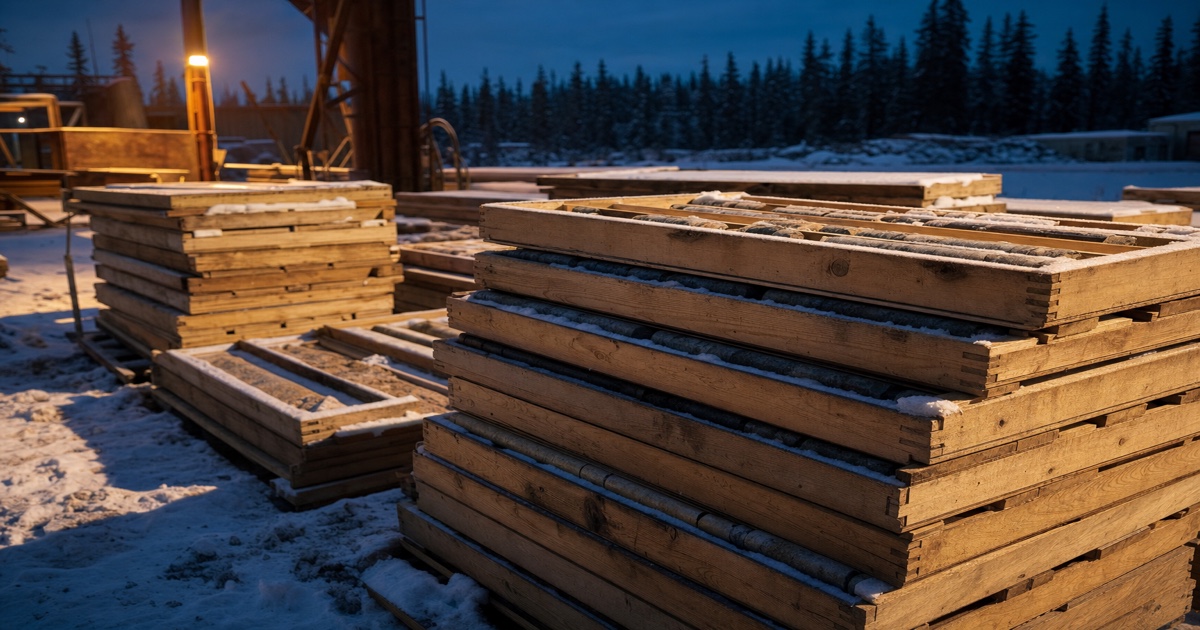
Choosing the right core box starts with the drill size you're using, how the core will be stored, and the conditions the boxes will face in the field. Most Canadian exploration programs drill NQ or HQ core, which typically calls for a 63" core box length with two to five rows, depending on drill size and box configuration. For those programs, customers generally choose either lighter plywood core boxes or durable 2×6" and 2×8" framed boxes built for outdoor storage and heavy stacking. Smaller early-stage programs may run BQ to reduce drilling cost; PQ shows up on metallurgical and geotechnical work that needs larger core samples and increased recovery. If you only remember one thing: for most projects a 63" box in 2×6" or 2×8" NQ construction is the standard choice — send us your metreage, drill size, and delivery location and we'll recommend a configuration, confirm lead times, and typically return pricing within one business day.
Start with drill size, storage, and field conditions
Choosing the right core box comes down to three questions: the drill size you're running, how the core will be stored, and the conditions the boxes will face in the field. Get those three right and the rest of the spec follows. Most Canadian exploration programs drill NQ or HQ core, which typically calls for a 63" core box length with two to five rows, depending on the drill size and box configuration.
Step 1 — Match the box to your drill size
The first thing we ask any new customer is what they're drilling with. The answer is one of five letters from the DCDMA wireline standard: AQ, BQ, NQ, HQ, or PQ. That single answer tells us the core diameter, how heavy the core will be per foot, and which box is the right starting point.
| Drill size | Core diameter | Typical use |
|---|---|---|
| AQ | 27 mm | Geotechnical, shallow |
| BQ | 36.5 mm | Early-stage, lower-cost drilling |
| NQ | 47.6 mm | Standard exploration |
| HQ | 63.5 mm | Standard exploration, deeper holes |
| PQ | 85 mm | Metallurgical / geotechnical, high recovery |
The bulk of the programs we ship to run NQ or HQ. Smaller, early-stage programs sometimes drill BQ to reduce drilling costs. PQ is commonly used on metallurgical and geotechnical programs that require larger core samples and increased recovery.
Step 2 — Pick the box construction
The choice between constructions depends on how rough the storage life of the box is going to be, not on the drill size.
Plywood core boxes
Our plywood core boxes are constructed from exterior-grade plywood with crosswise dividers that support the core and reduce movement during handling. They are lighter than framed boxes and are commonly used in core shacks, indoor storage facilities, short-term exploration programs, and projects where core will be scanned, sampled, and archived within a single season.
2×6" framed boxes (the standard)
Our 2×6" core boxes are manufactured from kiln-dried Canadian spruce with a standard 63" core box length and precisely machined end blocks. Built for demanding exploration environments, these boxes maintain their shape through freeze-thaw cycles, withstand rough handling in the field, and can be stacked up to thirty boxes high. For long-term outdoor storage — especially across Northern Manitoba and Saskatchewan — solid-construction 2×6" and 2×8" boxes remain the industry standard.
Custom PQ boxes
For PQ drilling, we manufacture heavy-duty custom boxes from 1×4 construction lumber. Because PQ core is significantly heavier than NQ or HQ core, these boxes are often built as single-row units and produced on our automated PQ core box production line to support high-volume drilling programs.
Step 3 — Order the right quantity
Most exploration programs order approximately 25% more boxes than metreage calculations indicate, to account for additional runs, lost core, broken ground, and unexpected drilling extensions. Because we keep standard NQ and HQ boxes in production year-round, large orders can ship quickly when a program expands or a schedule changes unexpectedly.
Supplying exploration projects across Canada
Greg's Manufacturing has supplied core boxes to exploration and mining companies across Canada for decades. Standard NQ and HQ boxes are kept in production year-round, which lets large orders ship quickly when drilling programs expand or schedules change.
We ship core boxes across Canada from Cranberry Portage, Manitoba, with customers throughout Manitoba, Saskatchewan, Ontario, British Columbia, Yukon, and Nunavut. Standard NQ and HQ stock sizes typically ship within one week. Custom dimensions and large-volume orders of 10,000+ boxes are generally scheduled into dedicated production runs.
If you only remember one thing
For most exploration projects, a 63" core box length in 2×6" or 2×8" NQ construction remains the standard choice. If you're planning a drilling program, send us your estimated metreage, drill size, and delivery location. We'll recommend the appropriate box configuration, confirm lead times, and typically provide pricing within one business day.
Ready for pricing?
Send a single message with your planned metreage, drill size (AQ, BQ, NQ, HQ, or PQ), and delivery location. We'll review the requirements, recommend the appropriate core box configuration, and provide pricing and lead times — usually within one business day. Reach the shop at our contact page or see the full CanadaCoreBox lineup. Comparing suppliers? Our wooden core boxes Canada page covers sizes, construction specs, and shipping in one place.
Frequently asked questions
What size core box do I need for NQ or HQ drill core?
Most Canadian exploration programs drilling NQ or HQ core use a 63-inch core box length with two to five rows, depending on the drill size and box configuration. For these programs customers generally choose either lighter plywood core boxes or solid 2×6" and 2×8" framed boxes built for outdoor storage and heavy stacking. Across Northern Manitoba and Saskatchewan, solid-construction 2×6" and 2×8" boxes remain the industry standard for long-term outdoor storage.
What is the difference between AQ, BQ, NQ, HQ, and PQ core boxes?
Those letters are the DCDMA wireline bit sizes, and they describe the core diameter, not the box. AQ is 27 mm, BQ is 36.5 mm, NQ is 47.6 mm, HQ is 63.5 mm, and PQ is 85 mm. A larger core needs a wider row and weighs more per foot, so bigger sizes generally need stronger construction. NQ and HQ are by far the most common in Canadian mineral exploration. Smaller early-stage programs sometimes run BQ to reduce drilling costs, while PQ is used on metallurgical and geotechnical programs that need larger samples and increased recovery.
Should I order plywood core boxes or 2×6" framed core boxes?
Match the material to the storage conditions. Plywood core boxes are lighter and commonly used in core shacks, indoor storage, short-term exploration programs, and projects where core will be scanned, sampled, and archived within a single season. Solid 2×6" and 2×8" framed boxes provide greater durability for multi-season outdoor storage and long-term core preservation, and they hold their shape through freeze-thaw cycles. Plywood performs well indoors for years but can deteriorate once it's exposed to weather after repeated handling.
How long are standard core boxes?
The standard core box length is 63 inches. Sticking to a standard length means boxes stack and ship consistently across a program. We also build custom dimensions on request when a project needs specific row counts or sizes.
How do I choose a box for PQ drilling?
PQ core is significantly heavier than NQ or HQ core, so PQ boxes are built differently. We manufacture heavy-duty custom PQ boxes from 1×4 construction lumber, often as single-row units, and produce them on our automated PQ core box production line to support high-volume drilling programs. PQ shows up most often on metallurgical and geotechnical work that needs larger core samples and increased recovery.
How many core boxes should I order for a drilling program?
Most exploration programs order roughly 25% more boxes than the metreage calculation indicates, to account for additional runs, lost core, broken ground, and unexpected drilling extensions. Standard NQ and HQ boxes are kept in production year-round, so large orders can ship quickly when a program expands or schedules change.
Need a quote on a real drilling program?
Tell us your meterage, your bit size, and your timeline. We'll come back with a real number — usually the same day.
Get a quote